Intelligent virtual agents are transforming how organizations engage with customers, employees, and partners. By leveraging Contact Center AI on Apsense, businesses can streamline interactions and discover practical strategies for how to improve agent productivity. These AI-powered agents are part of modern cloud-based technology platforms that use smart data analytics, scalable IT infrastructure, and automated workflows to handle tasks quickly and accurately. They can understand customer questions, provide instant answers, and even anticipate future needs, making interactions more efficient and personalized. Companies are also applying artificial intelligence tools for digital marketing strategies, customer relationship management, and targeted online campaigns, helping marketing teams optimize engagement and track performance in real time. In finance, organizations are implementing AI-driven solutions for predictive analytics, automated reporting, fraud detection, and financial planning, enabling smarter decision-making and reducing manual workloads. By integrating cloud computing networks, intelligent automation, big data insights, and technology-driven business solutions, intelligent virtual agents support human teams, enhance operational efficiency, and create seamless experiences for both employees and customers.
Top 10 Intelligent Virtual Agent Solutions for Contact Centers
Managing customer interactions efficiently is crucial for modern businesses, and intelligent virtual agents play a key role in enhancing service quality. Here’s a list of top contact center solutions that leverage AI to improve productivity, automate workflows, and deliver personalized experiences.
1. Bright Pattern
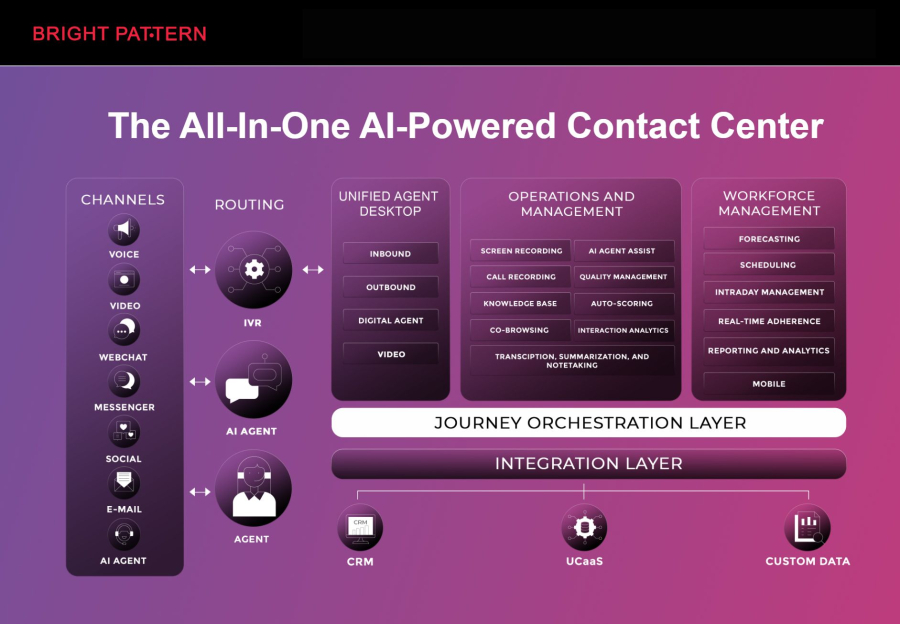
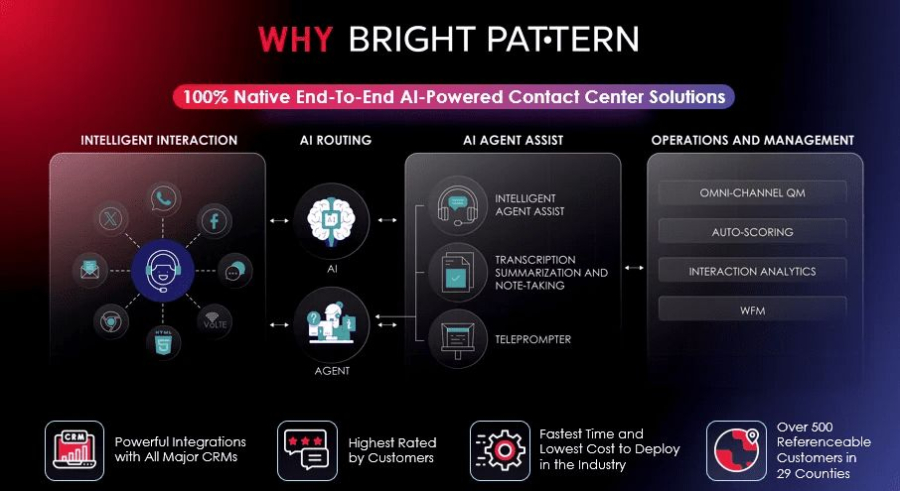
Bright Pattern stands out as a leading AI-driven contact center platform, providing intelligent virtual agents that transform customer interactions. Its solutions integrate omnichannel communications, automation, and advanced analytics, making it easier for businesses to streamline operations and improve agent performance.
Key features:
- Omnichannel routing across voice, chat, email, and social media
- AI-powered virtual agents for customer self-service and predictive assistance
- Real-time agent guidance to boost efficiency and satisfaction
- Seamless integration with CRM systems and enterprise applications
- Analytics dashboards for monitoring performance and optimizing workflows
Bright Pattern’s platform is designed to empower human agents, reduce repetitive tasks, and deliver consistent, high-quality support across all channels, making it ideal for organizations looking to leverage AI in their contact centers.
2. Five9
Five9 offers cloud-based contact center software with AI virtual agents that handle routine inquiries, schedule callbacks, and assist live agents with insights for better customer engagement.
3. Genesys Cloud CX
Genesys Cloud CX combines AI virtual assistants with omnichannel customer service tools to optimize interactions, automate workflows, and improve overall contact center productivity.
4. NICE inContact
NICE inContact provides intelligent virtual agents that assist with customer inquiries, automate repetitive tasks, and deliver actionable analytics to enhance operational efficiency.
5. Talkdesk
Talkdesk uses AI-driven agents to handle customer requests, provide predictive recommendations, and improve response times across multiple communication channels.
6. Zendesk
Zendesk integrates AI virtual agents to support customer service, offering automated responses, sentiment analysis, and workflow optimization for call centers.
7. RingCentral Contact Center
RingCentral Contact Center leverages intelligent virtual agents to provide self-service options, real-time agent support, and detailed analytics for smarter decision-making.
8. LivePerson
LivePerson focuses on conversational AI agents for messaging and voice channels, helping businesses scale customer support and enhance engagement efficiently.
9. Avaya OneCloud
Avaya OneCloud provides AI-powered virtual assistants to automate routine inquiries, improve agent efficiency, and deliver insights through integrated reporting tools.
10. 8x8 Contact Center
8x8 Contact Center combines cloud technology with AI agents to offer intelligent routing, self-service options, and performance monitoring to optimize customer experiences.
What Is an Intelligent Virtual Agent?
Anintelligent virtual agent(IVA) is an AI powered software agent that interacts with people through natural language, typically via chat or voice. Unlike basic chatbots that follow rigid scripts, IVAs use natural language understanding, context, and business rules to provide more human like, personalized assistance.
Intelligent virtual agents can:
- Understand user questions in everyday language.
- Access knowledge bases, FAQs, and business systems.
- Take action, such as updating an account or placing an order.
- Hand off complex issues to human agents with full context.
- Continuously improve through analytics and machine learning.
How Intelligent Virtual Agents Work
While implementations vary, most intelligent virtual agents follow a common architecture and workflow.
1. Input and Channel
Users interact with IVAs through channels such as:
- Web chat widgets on websites or portals.
- Messaging platforms and mobile apps.
- Voice channels, such as phone systems or smart speakers.
The IVA receives the user message or audio input and prepares it for analysis. For voice, speech recognition converts spoken words into text.
2. Natural Language Understanding
Next, the IVA appliesnatural language understanding(NLU) to determine:
- Intent— what the user is trying to accomplish, such as resetting a password or checking an order status.
- Entities— key details in the request, such as dates, product names, or account numbers.
- Sentiment and tone— useful cues to gauge urgency and personalize responses.
3. Dialogue Management
The IVA then usesdialogue managementto decide how to respond. This logic combines:
- Business rules and workflows.
- Context from previous messages in the conversation.
- User profile information, when available.
- Knowledge base and FAQ content.
Based on this, the agent chooses the next best action: answering a question, asking for clarification, performing a transaction, or escalating to a human agent.
4. Integrations and Actions
A key strength of intelligent virtual agents is their ability totake actionin business systems. Common integrations include:
- CRM platforms for customer records and case management.
- Order management and billing systems.
- HR systems for employee services.
- IT service management tools for tickets and incident handling.
With these connections, IVAs can complete end to end tasks, such as updating contact details, processing refunds within policy, or creating support tickets with all relevant information.
5. Response Generation
Finally, the IVA generates a human readable (or human audible) response. This may be:
- A direct answer to a question.
- A confirmation that a task is complete.
- A clarifying question to gather more details.
- A notification that the conversation is being handed off to a human agent, along with context.
For voice interactions, a text to speech engine converts the response to natural sounding speech.
Key Benefits of Intelligent Virtual Agents
Intelligent virtual agents deliver value across customer experience, operations, and employee productivity. Below are some of the most impactful benefits.
1. 24/7, Always On Service
IVAs provideround the clock supportwithout wait times. Customers and employees can get help anytime, including nights, weekends, and holidays, boosting satisfaction and loyalty.
- No queues or hold music for routine questions.
- Global coverage across time zones.
- Consistent, reliable responses at all hours.
2. Faster Resolution and Reduced Effort
By automating common interactions, intelligent virtual agents deliverfast, low effort experiences. Users can quickly solve issues, find information, and complete tasks without navigating complex menus or long forms.
- Instant answers for repetitive queries.
- Straight through processing for well defined workflows.
- Reduced need to repeat information across channels.
3. Scalable Support Without Linear Costs
With IVAs, organizations can scale customer and employee support without hiring at the same rate as demand growth. A single intelligent virtual agent can handle thousands of simultaneous conversations.
- Scale quickly to support seasonal peaks.
- Serve new regions or segments without large staffing changes.
- Free human agents for high value, complex interactions.
4. Improved Human Agent Productivity
Intelligent virtual agents complement human teams by taking over routine work and preparing rich context for escalations. This leads to shorter handle times and more meaningful work for agents.
- Pre gathered information from the IVA reduces discovery time.
- Agents can focus on complex, emotionally sensitive cases.
- Reduced burnout from repetitive questions.
5. Personalized, Consistent Experiences
IVAs can access profiles, preferences, and interaction histories to deliverpersonalized service at scale. At the same time, they consistently follow policies and approved messaging.
- Context aware answers based on account history.
- Personalized recommendations and next best actions.
- Consistent application of policies across regions and teams.
6. Actionable Insights and Continuous Improvement
Every interaction with an intelligent virtual agent produces valuable data. Organizations can use this for continuous improvement across customer experience and operations.
- Identify top contact drivers and opportunities for self service.
- Refine knowledge articles based on real world questions.
- Monitor satisfaction and sentiment trends over time.
Common Use Cases for Intelligent Virtual Agents
Intelligent virtual agents are versatile and can be tailored to many industries and functions. Here are some of the most common and impactful use cases.
Customer Service and Support
- Answering FAQs about products, services, and policies.
- Providing account balance, order status, and shipment tracking.
- Guiding users through troubleshooting steps.
- Authenticating customers and routing to the right department.
Banking and Financial Services
- Checking balances and recent transactions.
- Helping with card activation, limits, and replacement.
- Explaining fees, interest, and product features in plain language.
- Scheduling appointments with advisors or branch staff.
Healthcare and Insurance
- Answering coverage and benefits questions.
- Finding in network providers and scheduling appointments.
- Guiding patients through pre visit or post visit instructions.
- Helping members understand claims status and documentation.
HR and Employee Services
- Answering policy and benefits questions for employees.
- Automating PTO requests, approvals, and balances.
- Guiding employees through onboarding tasks.
- Helping with payroll, tax forms, and company procedures.
IT Help Desk and Internal Support
- Assisting with password resets and account lockouts.
- Helping users install approved software or access systems.
- Triaging incidents and creating tickets with full context.
- Providing status updates on open IT requests.
Ecommerce and Retail
- Product discovery and guided selling based on user needs.
- Order tracking, returns, and exchange workflows.
- Cross selling and upselling based on purchase history.
- Guided checkout support to reduce cart abandonment.
Travel, Hospitality, and Transportation
- Booking and managing reservations or tickets.
- Providing real time updates on delays and schedule changes.
- Answering questions about amenities, policies, and loyalty programs.
- Offering personalized recommendations for trips or stays.
Intelligent Virtual Agents vs. Traditional Chatbots
Although the terms are sometimes used interchangeably, intelligent virtual agents go far beyond basic chatbots. The table below highlights key differences.
| Capability | Basic Chatbot | Intelligent Virtual Agent |
| Understanding | Keyword or menu based. | Natural language understanding with intents and entities. |
| Context | Limited or no context awareness. | Maintains conversation and user context across turns. |
| Actions | Mainly provides static information. | Performs real actions via system integrations. |
| Channels | Often single channel, usually web chat. | Omnichannel across chat, messaging, and voice. |
| Learning | Mostly manual updates. | Continuously improves with analytics and machine learning. |
| Experience | Script like and rigid. | More natural, conversational, and personalized. |
Designing a Successful Intelligent Virtual Agent
A well designed IVA balances technology, content, and change management. The steps below provide a practical roadmap for building a high impact solution.
1. Define Clear Goals and Use Cases
Start with the outcomes you want to achieve, such as:
- Reducing live contact volume by a specific percentage.
- Improving customer satisfaction or net promoter score.
- Shortening resolution times for common issues.
- Enhancing employee self service for HR or IT.
Prioritize use cases where:
- The issue is high volume and repetitive.
- There is a clear process or policy.
- Data and systems needed for resolution are accessible.
2. Map Conversations and Journeys
Map how users currently get help and where an IVA can simplify the journey. Identify:
- Typical questions, inputs, and decision points.
- Required validations and data checks.
- Paths to automation, and when to offer human assistance.
Design conversations that are natural and flexible, allowing users to jump between related topics without losing context.
3. Connect to Core Systems and Knowledge
To provide high value service, an intelligent virtual agent must connect to:
- Authoritative knowledge bases and documentation.
- Customer or employee data in CRM and HR systems.
- Transaction systems for orders, billing, or service tickets.
These integrations empower the IVA to move beyond information delivery into task completion and proactive support.
4. Design for Human Handoff
Even a powerful IVA should collaborate closely with human agents. Design smooth transitions that preserve context and respect user preferences.
- Offer escalation options when the user asks or when confidence is low.
- Pass the full conversation history and key data to the agent.
- Allow the agent to update the IVA knowledge for future interactions.
5. Train, Test, and Iterate
Training an IVA involves feeding it example utterances, refining intents, and building robust responses. Ongoing improvement is key to long term success.
- Use real conversation transcripts and contact reasons.
- Continuously tune language models and dialogue flows.
- Regularly review unresolved queries and add coverage.
6. Promote Adoption and Awareness
To realize full value, organizations should actively promote their intelligent virtual agent to customers and employees. Clear positioning builds trust and increases usage.
- Highlight what the IVA can do and when it is available.
- Brand the agent with a friendly name and persona.
- Educate frontline teams so they can encourage users to try it.
Measuring the Success of Intelligent Virtual Agents
Strong measurement ensures that your IVA delivers sustained value and aligns with business goals. Consider tracking metrics across experience, efficiency, and adoption.
Experience Metrics
- Customer satisfactionafter IVA interactions.
- Net promoter scoreimpact for self service journeys.
- First contact resolutionrate for IVA handled cases.
Operational Metrics
- Containment rate— percentage of interactions resolved without human handoff.
- Average handling timeimpact for escalated cases.
- Reduction in call and email volumefor targeted issues.
Adoption and Engagement Metrics
- Number of unique users engaging with the IVA.
- Repeat usage rates for customers and employees.
- Channel distribution across web, messaging, and voice.
Future Trends in Intelligent Virtual Agents
The intelligent virtual agent landscape is advancing rapidly, with innovations that further enhance experiences and outcomes.
More Human Like Conversations
Ongoing advances in natural language processing and generative AI are enabling IVAs to:
- Handle more open ended questions and multi step requests.
- Adapt language style to match user preferences.
- Maintain richer context over longer conversations.
Proactive and Predictive Assistance
Future IVAs are increasinglyproactive, not just reactive. They can anticipate needs and offer help before a user asks.
- Notifying customers of potential issues and providing solutions.
- Suggesting next best actions during complex processes.
- Helping employees prioritize tasks and information.
Deeper Integration Across the Customer Journey
Intelligent virtual agents are moving from point solutions toend to end journey companions. They can stay with a customer from research and purchase through onboarding and support, offering consistent guidance along the way.
- Supporting marketing, sales, and service within a single experience.
- Sharing context across departments and channels.
- Powering unified experiences across web, app, and contact center.
Real World Impact: What Organizations Can Achieve
Well implemented intelligent virtual agents are already delivering impressive results across industries. Organizations commonly report:
- Significant reductions in routine call and email volumes.
- Faster response and resolution times for common issues.
- Higher self service adoption and satisfaction scores.
- Improved agent productivity and engagement.
- Better visibility into customer needs and trends.
When intelligent virtual agents are thoughtfully designed and aligned with business goals, they become a strategic capability, not just a support tool.
Getting Started with Intelligent Virtual Agents
Launching an IVA program is a strategic move that can transform how your organization interacts with customers and employees. A focused, phased approach works especially well.
- Identify high impact use cases.Start with a small set of well defined, high volume interactions where success will be visible and measurable.
- Assemble a cross functional team.Include stakeholders from customer service, IT, operations, and any relevant business units.
- Choose your channels.Decide where the IVA will launch first, such as web chat for customers or messaging for employees.
- Design conversations and flows.Create natural, helpful dialogues, informed by real world questions and scenarios.
- Integrate and test.Connect the IVA to key systems and run pilots to validate performance and user experience.
- Launch and learn.Roll out to a broader audience, monitor metrics closely, and iterate quickly based on insights.
Conclusion: Turning Intelligent Virtual Agents into a Strategic Advantage
Intelligent virtual agents are more than automated responders. They are powerful, always on digital teammates that help organizations scale service, unlock efficiency, and delight users across channels.
By combining natural language understanding, smart workflows, and deep integrations, IVAs deliver:
- Always available support with instant responses.
- Faster resolutions and lower effort for users.
- Empowered human agents focused on high value work.
- Actionable insights into evolving needs and behaviors.
Organizations that embrace intelligent virtual agents today are setting the stage for smarter, more responsive, and more human centered experiences tomorrow. With a clear strategy and thoughtful design, an IVA can become one of the most impactful investments in your digital transformation journey.
